
Larnaca apartments with long-term value
Updated: Jun 13
A premium property in Cyprus has to do two jobs well. It needs to feel right the moment you walk in, and it needs to make commercial sense years after purchase. That is why demand for Larnaca flats has moved beyond simple holiday buying and into a more disciplined conversation about location, build quality, rental performance and operational control.
The long-term track record supports that discipline. Residential property prices in the Larnaca district have risen approximately 55% since 2015, according to Central Bank of Cyprus data. In Q2 2025, apartment prices in the district accelerated to 8.2% annual growth, the strongest apartment growth rate of any quarter that year. The RICS Cyprus Property Index with KPMG confirmed Larnaca as the district with the strongest overall price increases in both Q1 and Q2 of 2025. And the Central Bank has stated there are no signs of widespread overvaluation, which means the appreciation reflects genuine demand rather than speculative froth.
Larnaca has become one of the clearest examples of a market where lifestyle and investment are no longer separate decisions. Buyers are looking for modern residences near the sea, close to the airport, and within well-positioned neighbourhoods that support year-round use. Investors are looking at the same assets through a different lens: occupancy potential, ease of management, quality of tenants and resilience of resale value.
Why Larnaca flats attract serious buyers
Larnaca offers a rare balance. It is established enough to provide infrastructure, services and international accessibility, yet still presents room for upward movement compared with more saturated Mediterranean locations. Apartment prices average €2,100 to €2,400 per square metre, still 30% to 40% below Limassol, yet growth rates have repeatedly outpaced the national average. Analysts describe this as a "catch-up trade," where buyers priced out of prime Limassol discover comparable coastal quality at significantly lower price points.
The city's appeal starts with practicality. Larnaca International Airport handled 9.91 million passengers in 2025 (up 14% year on year), served by 60 airlines on 160 routes to 41 countries. The airport sits approximately 15 minutes from the city centre. The seafront, marina areas, residential districts and nearby growth locations create a broad base of demand, not a market reliant on one single buyer profile. The district's tenant base includes local professionals, international workers, expats, university students (via the UCLan Cyprus campus in Pyla) and holiday visitors.
It also helps that Larnaca remains liveable beyond the peak season. Cyprus recorded significant expansion in winter travel during 2025, with new routes to Rome, Brussels and Warsaw, and available airline seats exceeding 2019 levels by 12%. For owners, that means genuine usability. For investors, it means a more consistent rental story, whether the property is positioned for holiday lets, medium-term stays or long-term occupation.
What separates premium flats from average stock
Not all flats in Larnaca compete on the same level. The gap between standard stock and genuinely premium product is often wider than it first appears. The premium segment tells its own story: Larnaca recorded 823 residential transactions in H1 2025, with 23% (192 properties) falling in the mid-to-high category. Prices in this premium segment grew 10.2% between Q1 2024 and Q1 2025. Buyers who focus only on price per square metre usually miss this distinction.
A strong flat development starts with planning discipline. Layout efficiency, natural light, privacy, orientation and usable outdoor space all affect both the living experience and the asset's future performance. A flat that photographs well but feels compromised in person will struggle to command a premium over time.
Build quality is the next filter. New-build prices across the Larnaca district have risen 15% to 20% since 2022, reflecting the premium that buyers place on energy-efficient, modern-specification homes. Materials, facade durability, thermal performance, common-area finish and mechanical systems may not create the first impression that a roof terrace or pool does, but they influence maintenance costs, owner satisfaction and tenant retention. In premium real estate, specification is not decoration. It is a risk-control measure.
Amenities also need to be judged properly. A development with resort-style features can be highly attractive, but only when those features are practical, well managed and aligned with the target market. Communal or building management fees typically range from €80 to €350 per month for apartments in managed complexes. There is little value in excessive extras that increase service costs without improving desirability. The strongest schemes combine visual appeal with operational sense.
Location still decides most of the outcome
Within Larnaca, micro-location often matters more than the broader postcode. Two developments may sit only minutes apart and perform very differently depending on access, outlook, surrounding stock and neighbourhood trajectory.
The data highlights clear winners. Neighbourhoods such as Mackenzie and Drosia are projected to see price growth of 5% to 8% in 2026, roughly double the national average. Mackenzie has earned a reputation as Larnaca's fastest-changing neighbourhood, attracting a wave of cafes, restaurants and boutique developments, signalling the early stages of a gentrification cycle. Drosia benefits from proximity to key schools, the Finikoudes beachfront and the port regeneration area.
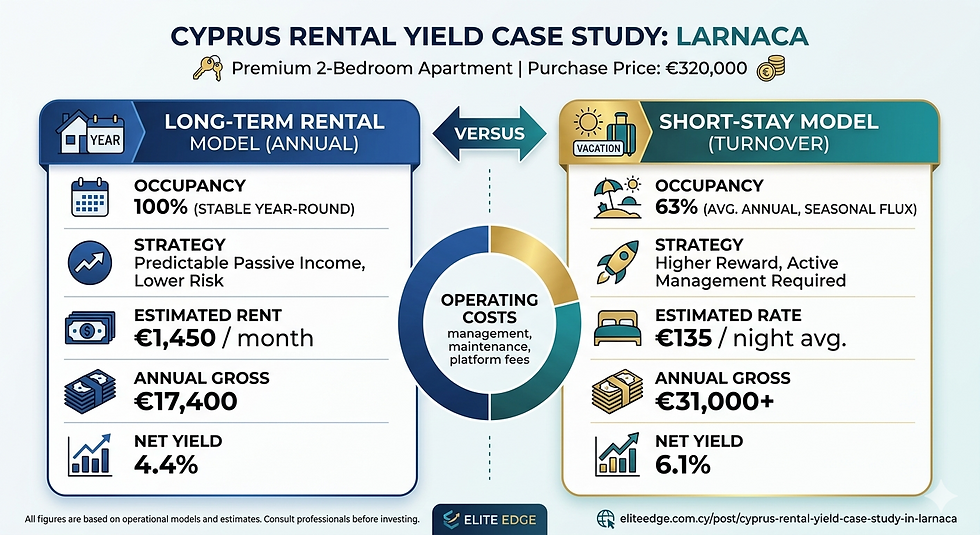
Buyers focused on lifestyle tend to prioritise beach proximity, privacy, dining access and the overall quality of the area. Investors will usually add other questions. Is the location attractive to year-round tenants? Does it suit business travellers or seasonal visitors? Is there enough nearby infrastructure to support repeat demand? City-centre apartments in Larnaca can achieve gross rental yields of 5.4% to 7.4%, among the highest in Cyprus, while holiday apartments yield approximately 5.7% (RICS 2025).
Emerging residential pockets and nearby areas such as Pyla deserve attention for exactly this reason. Over 1,000 residential units are under construction in Pyla, with permits for a further 1,000 awaiting approval. Entry prices start from approximately €130,000 to €150,000 for flats. The right location does not simply look good today. It shows evidence of durability.

The investment case for Larnaca flats
There is a tendency in overseas property markets to overstate returns and understate management realities. Serious buyers know better.
The benchmarks are clear. Apartment rental yields in Cyprus average approximately 5.4% gross (RICS 2025), notably higher than the 3% to 4% typical in Greece or Portugal. Short-term holiday rentals can generate 6% to 8% gross in tourist-area locations, with Larnaca's short-term rental occupancy reaching 75% in 2025 and average revenue per listing across Cyprus rising 20.5% year on year to approximately €31,460. Cyprus has no national cap on short-term rental days, unlike Spain, France and Portugal, giving owners full-year revenue flexibility.
Capital appreciation adds a meaningful additional layer. At the district's average annual apartment growth rate (which has ranged from 4% to 8% depending on the quarter and property type), a €300,000 apartment could appreciate by €12,000 to €24,000 per year before any rental income. Combined with net rental returns, total annual returns in the 8% to 11% range are achievable for well-located, well-managed assets.
The fiscal environment supports long-term holding. Cyprus abolished its annual immovable property tax in 2017. Rental income benefits from an automatic 20% deemed expense deduction before tax, and the progressive income tax scale starts at 0% on the first €22,000 of annual income (as of 2026). The ECB deposit rate has dropped from 4% in 2023 to approximately 2% by early 2026, translating to roughly 15% more purchasing power for mortgage buyers.
For non-EU buyers, a new-build purchase of at least €300,000 qualifies for Cyprus Permanent Residency, a lifetime permit with processing as fast as four to six months. Discussions about raising this threshold to €500,000 create an incentive to act at the current level.
That said, returns always depend on the exact product. Lower entry pricing can conceal weaker occupancy, higher maintenance exposure and slower capital growth. Net performance is shaped by service quality, maintenance standards, marketing execution, turnover efficiency and the ease with which the property can be kept in excellent condition.
Why full lifecycle control matters
One of the most overlooked advantages in residential real estate is continuity. When design, development, delivery and ongoing management sit under aligned control, the ownership experience becomes more predictable and the asset is often better protected.
This is especially relevant given the scale of overseas ownership. More than 53,000 properties in Cyprus have been transferred to third-country nationals, with 9,175 in Larnaca alone. Most of these owners manage from abroad. Larnaca added nearly 300 new Airbnb listings in 2025 (a 28.75% increase), which means the market is growing more competitive. In that environment, the properties that maintain high occupancy and strong nightly rates are those with consistently high operational quality.
A vertically integrated model addresses that challenge. It creates accountability across the property lifecycle, from specification decisions made before construction to the day-to-day standards that shape occupancy and long-term presentation. For owners who do not live in Cyprus full time, this is more than convenience. It is a serious value consideration.
This is where an operator such as EliteEdge stands apart. Full control over design, execution, delivery and property management gives buyers a clearer line of sight from acquisition to ownership outcomes.
What buyers should assess before committing
The strongest purchase decisions are rarely driven by emotion alone, even in the luxury segment.
Start with the residence. Does the layout suit actual living, not just brochure imagery? Are terraces generous and private? Is storage adequate? Is the finish level consistent throughout? Small compromises in these areas often become major frustrations later.
Then assess the building. Premium communal areas should feel considered rather than decorative. Parking, security, lift access, entrance quality and maintenance planning all affect the overall standard.
Model your total costs early. Acquisition costs in Cyprus typically total 6% to 11% of the purchase price. New-build properties carry 19% VAT (5% reduced rate on the first €350,000 for eligible buyers). After purchase, there is no annual property tax, but communal fees and management costs should be budgeted.
Finally, look closely at management capability. For owner-occupiers, this influences service quality and peace of mind. For investors, it shapes income reliability. A well-run property should not depend on improvisation.
Lifestyle value and commercial value are now connected
In many Mediterranean markets, there used to be a perceived trade-off between buying for personal enjoyment and buying for return. In Larnaca, that distinction is less rigid. The features that make a flat desirable for owners, including modern design, strong location, quality amenities, ease of access and dependable management, are often the same features that support rental demand and resale confidence.
The structural tailwinds reinforce this. Cyprus welcomed 4.53 million tourists in 2025 (up 12.2%), generating €3.69 billion in revenue. Tourism contributes 14% of GDP. The economy grew 3.75% in 2025, well above the eurozone average. The national property market recorded 18,114 transactions, the highest since 2007. Cyprus is on track to join the Schengen Area (target 2026/2027), which would further enhance the island's accessibility and desirability. The marina and port regeneration in Larnaca provides an additional forward-looking catalyst.
For buyers considering Cyprus, that is one of Larnaca's strongest advantages. It is a market where a residence can still feel personal while functioning as a disciplined asset. The best opportunities are not the loudest ones. They are the projects with clear location logic, credible execution and a management structure capable of protecting value after handover.
A good property should serve you on day one, but a well-chosen one should still look intelligent years later.


