
Cyprus Rental Yield Case Study in Larnaca
Updated: Aug 30
A buyer comparing Mediterranean markets will often ask one blunt question before anything else: what does the income really look like once the glossy brochure is put aside? That is exactly where a Cyprus rental yield case study becomes useful, because yield is never created by headline pricing alone. In Larnaca, the result depends on the property type, the micro-location, the quality of the scheme, and the standard of ongoing management after handover.
For context, Cyprus apartment rental yields average approximately 5.4% gross according to RICS 2025 data, notably higher than the 3% to 4% typical in Greece or Portugal. Holiday apartments yield approximately 5.7%. In Larnaca specifically, city-centre apartments can achieve gross yields between 5.4% and 7.4%, some of the highest returns available anywhere in Cyprus. Those figures set the benchmark. The question is whether a specific property in a specific location can meet or exceed them, and what it takes to get there.
This matters most to buyers who are not looking at property as a passive ornament. If the objective is to secure a well-positioned residence that can also generate dependable rental performance, then assumptions need to be tested against a realistic operating model. The strongest assets tend to work because design, neighbourhood positioning, occupancy strategy and property management are aligned from the start.
A Cyprus rental yield case study built on realistic assumptions
For this case study, consider a premium two-bedroom flat in Larnaca within a modern residential development close to the coast, everyday amenities, and key transport routes. The property is not ultra-luxury in the sense of being a one-off villa, but it sits firmly in the high-quality segment that attracts professional tenants, relocating residents, and seasonal demand from visitors seeking a more elevated stay.
Assume a purchase price of €320,000 for a newly built flat with strong specifications, contemporary architecture, private parking, and communal features that support rental appeal. For reference, apartment prices in the Larnaca district currently average €2,100 to €2,400 per square metre, and demand is concentrated in the €200,000 to €350,000 range, especially near major infrastructure developments. The flat is professionally presented and maintained, with a layout designed for practical living rather than purely decorative effect. That distinction matters, because tenants pay for ease, comfort and location consistency as much as they pay for visual appeal.
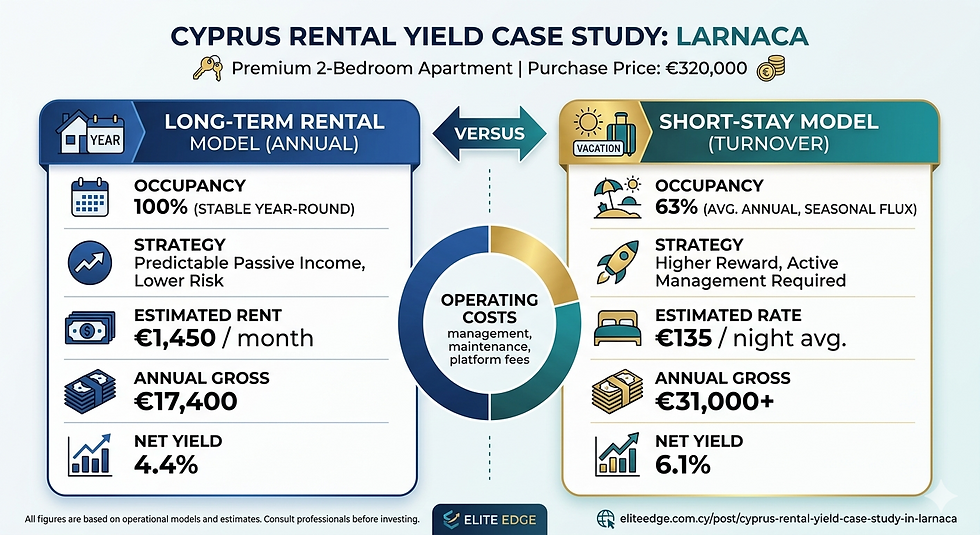
Now assume two rental strategies are possible. The first is a long-term let aimed at stable occupancy over a full year. The second is a flexible short-stay model designed to capture stronger seasonal rates, with professional management in place to handle bookings, cleaning, guest communication and maintenance.
Under a long-term arrangement, the flat may achieve around €1,450 per month, depending on exact location and specification. That produces annual gross rental income of €17,400. On a gross yield basis, the calculation is straightforward: annual rent divided by purchase price. In this scenario, the gross yield is around 5.4%, directly in line with the national RICS apartment average and well within the Larnaca city-centre range.
That is a respectable figure for a premium residential asset in a desirable coastal market. For comparison, the average rental yield in Cyprus is significantly higher than most Western European markets: roughly 5.4% for apartments versus 3% to 4% in Greece or Portugal. But gross yield only tells part of the story. Investors who rely on gross figures alone usually end up misreading performance.
Gross yield looks clean. Net yield is where the case becomes credible
To assess the true return, operating costs must be brought into view. A high-standard flat in a well-managed building will typically carry communal charges (€80 to €350 per month for apartments in managed complexes, depending on amenities), routine maintenance costs, insurance and occasional repair provision. If the owner uses a professional management company, management fees also need to be factored in. These are not avoidable irritations: they are part of protecting the asset and sustaining rent levels.
Using the same example, assume annual non-finance costs of roughly €3,200 under a long-term tenancy. This could include building common expenses, minor repairs, landlord insurance, and management oversight. With annual rental income of €17,400, that leaves €14,200 before tax and financing considerations. The net yield in this case moves closer to 4.4%.
From a tax perspective, Cyprus offers a favourable treatment. Rental income benefits from an automatic 20% deemed expense deduction before tax is calculated, meaning only 80% of gross rent is taxable. The progressive income tax scale starts at 0% on the first €22,000 of annual income (as of 2026), and Cyprus has no annual immovable property tax (abolished in 2017). GHS contributions of 2.65% apply on gross rental income. For a property generating €17,400 annually, the effective tax burden is relatively modest by European standards.
For many investors, the net figure of approximately 4.4% is the more relevant number. It is not inflated, and it reflects a property being run properly rather than cheaply. A lower-quality building may appear less expensive to operate in the short term, but over time poor maintenance, weaker tenant demand and pricing pressure can erode returns far more severely.
Short-stay income can outperform, but only with the right execution
The same flat could be positioned for short-term rental demand, particularly in periods of strong travel activity and seasonal movement into coastal locations. On paper, this often looks more attractive. In practice, it is more operationally demanding and more sensitive to service quality.
The market data provides useful context. Larnaca's short-term rental occupancy rate reached 75% in 2025 according to Airbtics data, matching the island's top-performing markets. Average daily rates in Larnaca typically peak in June and August and dip lowest in January. Top-performing properties (the top 10%) achieve nightly rates above $143, while the median sits around $82. The spread between median and top-tier is precisely where management quality, presentation and positioning make the difference. Average revenue per short-term rental listing across Cyprus rose 20.5% year on year to approximately €31,460 in 2025.
Assume the flat in this case study achieves an average nightly rate of €135 and an annual occupancy rate of 63%. That produces gross income of just over €31,000 across the year. At first glance, the yield appears significantly stronger than the long-term model.
But short-stay costs are materially higher. Cleaning turnover, linen services, platform commissions where applicable, guest support, marketing exposure, maintenance wear, utilities and more intensive management all need to be included. If these costs total around €11,500 annually, net operating income would sit near €19,500. Based on the same €320,000 purchase price, that implies a net yield of roughly 6.1%.
That premium over a conventional tenancy is meaningful, but it comes with variables. Occupancy can soften. Seasonality can compress demand outside peak windows. Guest expectations are less forgiving than tenant expectations. Owners should also be aware that Cyprus requires mandatory licensing for all short-term rental properties, with fines of up to €5,000 for non-compliance, and the EU Regulation 2024/1028 (effective May 2026) will mandate data sharing between platforms and authorities. However, Cyprus has no national cap on short-term rental days, unlike Spain, France or Portugal, giving owners full-year revenue flexibility.
The short-stay model can outperform, but only where the property is genuinely competitive and the management standard is consistently high.
The total return picture: income plus capital appreciation
Rental yield is only one component of total return. In Larnaca, capital appreciation adds a significant layer.
Residential property prices in the district have risen approximately 55% since 2015, according to Central Bank of Cyprus data. In Q2 2025, apartment prices in Larnaca accelerated to 8.2% annual growth, while the general residential index for the district rose 5.8%. The RICS Cyprus Property Index with KPMG confirmed Larnaca as the district with the strongest overall price increases in both Q1 and Q2 of 2025. The Central Bank has stated there are no signs of widespread overvaluation, suggesting this growth reflects genuine demand rather than speculative excess.
Applied to the case study flat: a €320,000 property appreciating at even 4% to 5% per year gains €12,800 to €16,000 in value annually. Combined with net rental income of €14,200 (long-term) or €19,500 (short-stay), the total annual return on a €320,000 investment could range from approximately 8.4% to 11.1% before tax and financing costs.
That combination of income plus appreciation is what makes Larnaca compelling relative to other Mediterranean markets. The ECB deposit rate has dropped from 4% in 2023 to approximately 2% by early 2026, translating to roughly 15% more purchasing power for mortgage buyers. For cash buyers, the yield spread over deposit returns has widened further, strengthening the relative case for property.
Why location inside Larnaca changes the numbers
A market-level average can be useful, yet investment performance is usually decided street by street rather than city by city. In Larnaca, properties near the seafront, established residential districts, and emerging growth pockets with strong infrastructure tend to support both better occupancy resilience and firmer rental pricing.
Neighbourhoods such as Mackenzie and Drosia are projected to see price growth of 5% to 8% in 2026, roughly double the national average. Growth areas such as Pyla, where over 1,000 residential units are under construction and the nearby UCLan Cyprus campus creates year-round student and faculty rental demand, offer a different but equally compelling proposition at more accessible entry points.
This is where a Cyprus rental yield case study becomes more than a spreadsheet exercise. A well-placed flat in a strong neighbourhood can outperform an apparently similar flat elsewhere because the tenant pool is deeper, daily convenience is better, and perceived quality is higher. Larnaca's tenant base is genuinely diverse, including local professionals, international workers, expats, university students and holiday visitors, supporting more stable year-round demand than purely resort-led locations.
Neighbourhood profile also shapes the right rental strategy. Some areas are better suited to year-round residential lets, particularly where professionals and families want stability. Others are stronger for mixed-use ownership, where holiday demand and lifestyle positioning support a short-stay model. Investors who match the asset to the correct audience usually achieve better income consistency than those chasing the highest advertised rate.
Development quality has a direct effect on yield
It is easy to treat development quality as a lifestyle issue rather than an investment issue. In reality, they are closely linked. Premium materials, efficient layouts, modern energy performance, secure access, parking provision and attractive common areas can improve both tenant retention and booking conversion. New-build prices across the Larnaca district have risen 15% to 20% since 2022, reflecting the premium that buyers place on modern-specification, energy-efficient homes.
There is also a subtler commercial benefit. Better schemes tend to age more gracefully. That supports rent levels over time and reduces the risk of the property looking dated after only a few seasons. For an investor holding over the medium to long term, this has a clear effect on income stability and exit value.
A vertically integrated operator has an advantage here because there is continuity between development standards and post-completion management. When design, build quality, occupancy strategy and maintenance are handled with one commercial logic, fewer gaps appear between projected performance and lived reality. That is particularly relevant in a market where overseas owners want income without day-to-day friction.
The trade-off between lifestyle use and pure return
Many Cyprus buyers are not making a purely financial purchase. They want a residence they can enjoy personally while also preserving the option to generate rental income. That hybrid objective is entirely valid, but it changes the yield profile.
If an owner reserves prime weeks for personal use, those weeks cannot produce income. In a short-stay model, they may also remove some of the strongest revenue periods from the calendar. A property can still perform well, but the owner should recognise that lifestyle use has an opportunity cost.
That does not make the investment weaker. It simply means the return should be judged more broadly. The asset is providing utility, flexibility and market exposure as well as income. For qualifying non-EU buyers, a €300,000+ new-build purchase also secures Cyprus Permanent Residency, adding a residency pathway to the return equation. For many affluent buyers, that combination of income, appreciation, personal use and residency eligibility is more attractive than pursuing a slightly higher yield in a less desirable property they would never choose to use themselves.
What this case study suggests for serious buyers
The central lesson is simple: yields in Cyprus can be attractive, but the best outcomes are rarely accidental. In Larnaca, a premium flat with strong location credentials and professional management can support gross yields above 5% on a long let and stronger net performance under a well-run short-stay model, with capital appreciation adding a meaningful additional layer.
Yet those figures depend on disciplined execution, not optimistic assumptions. The market context is supportive: Cyprus recorded 4.53 million tourists in 2025, €3.69 billion in tourism revenue, and Larnaca's airport handled 9.91 million passengers. But individual property performance is shaped by the four factors a buyer can actually control: location selection, asset quality, rental strategy, and management capability.
This is precisely why many sophisticated investors favour a developer with full control over design, execution, delivery and ongoing property management. Where one operator remains accountable across the lifecycle, forecasting tends to be sharper and ownership tends to be simpler. In a market like Larnaca, that operational clarity can be just as valuable as the property itself.
A strong investment property should do more than produce a promising first-year projection. It should remain desirable, manageable and commercially credible several years after purchase. That is the benchmark worth using when evaluating any opportunity in Cyprus.


